Friday, 15 May 2015

Magic milk

Aka Doof's first science experiment


If you've never heard of magic milk then you definitely need to try this out. Super simple (you will already have all the ingredients needed) and it kept D engrossed for over half an hour (a long time in toddler-time!).

What you need:
-  Milk (not skimmed - we used full fat and Iz's discarded formula)
-  Food colouring
-  Liquid soap
-  Cake pop stick (could also use a cotton bud or cocktail stick but I like cake pop sticks because they aren't sharp but are thin enough to be good fine motor practice for D)

What to do:


Pour a thin layer of milk into a bowl (if the layer is too deep the colours will get lost) and add a few drops of food colouring

Watch as they initially spread a little - weird how some colours spread much more than others! Then the fun bit - dip your stick into the liquid soap and then hold it in the milk


The colours will initially "run" away from it.But if you keep holding it in the same place they will then dance back towards it

Pretty patterns


We also made some pictures by dipping watercolour paper on top of the colours as they were spiralling. It was quite tricky for D to get the timing right though!

I love how simple this is to do but yet how much it held D's attention. Once we'd "used up" all the fat in the milk I just poured it away and poured out some more and D could start again. 

Sometimes it's nice to recognise just how many learning opportunities there are for toddlers in even simple activities. In this one D:
    - talked about colours
    - used new words like "swirl/whirl"
    - practised fine motor skills when squeezing the food colour bottles
    - followed new commands (eg "hold the stick still") 
    - learnt about cause and effect (after a few seconds he realised if he put the soapy stick end into an area of colour it would quickly swirl away and change its patten).

I'm not sure you could ask for much more from an activity with such a simple set-up?! If you're interested in the science behind it then you can read a great explanation here.
ilk is mostly water but it also contains vitamins, minerals, proteins, and tiny droplets of fat suspended in solution. Fats and proteins are sensitive to changes in the surrounding solution (the milk).
The secret of the bursting colors is the chemistry of that tiny drop of soap. Dish soap, because of its bipolar characteristics (nonpolar on one end and polar on the other), weakens the chemical bonds that hold the proteins and fats in solution. The soap's polar, or hydrophilic (water-loving), end dissolves in water, and its hydrophobic (water-fearing) end attaches to a fat globule in the milk. This is when the fun begins.
The molecules of fat bend, roll, twist, and contort in all directions as the soap molecules race around to join up with the fat molecules. During all of this fat molecule gymnastics, the food coloring molecules are bumped and shoved everywhere, providing an easy way to observe all the invisible activity. As the soap becomes evenly mixed with the milk, the action slows down and eventually stops.
Try adding another drop of soap to see if there's any more movement. If so, you discovered there are still more fat molecules that haven't found a partner at the big color dance. Add another drop of soap to start the process again
- See more at: http://www.stevespanglerscience.com/lab/experiments/milk-color-explosion#how-does-it-work

How Does It Work?

Milk is mostly water but it also contains vitamins, minerals, proteins, and tiny droplets of fat suspended in solution. Fats and proteins are sensitive to changes in the surrounding solution (the milk).
The secret of the bursting colors is the chemistry of that tiny drop of soap. Dish soap, because of its bipolar characteristics (nonpolar on one end and polar on the other), weakens the chemical bonds that hold the proteins and fats in solution. The soap's polar, or hydrophilic (water-loving), end dissolves in water, and its hydrophobic (water-fearing) end attaches to a fat globule in the milk. This is when the fun begins.
The molecules of fat bend, roll, twist, and contort in all directions as the soap molecules race around to join up with the fat molecules. During all of this fat molecule gymnastics, the food coloring molecules are bumped and shoved everywhere, providing an easy way to observe all the invisible activity. As the soap becomes evenly mixed with the milk, the action slows down and eventually stops.
Try adding another drop of soap to see if there's any more movement. If so, you discovered there are still more fat molecules that haven't found a partner at the big color dance. Add another drop of soap to start the process again.
- See more at: http://www.stevespanglerscience.com/lab/experiments/milk-color-explosion#how-does-it-work

How Does It Work?

Milk is mostly water but it also contains vitamins, minerals, proteins, and tiny droplets of fat suspended in solution. Fats and proteins are sensitive to changes in the surrounding solution (the milk).
The secret of the bursting colors is the chemistry of that tiny drop of soap. Dish soap, because of its bipolar characteristics (nonpolar on one end and polar on the other), weakens the chemical bonds that hold the proteins and fats in solution. The soap's polar, or hydrophilic (water-loving), end dissolves in water, and its hydrophobic (water-fearing) end attaches to a fat globule in the milk. This is when the fun begins.
The molecules of fat bend, roll, twist, and contort in all directions as the soap molecules race around to join up with the fat molecules. During all of this fat molecule gymnastics, the food coloring molecules are bumped and shoved everywhere, providing an easy way to observe all the invisible activity. As the soap becomes evenly mixed with the milk, the action slows down and eventually stops.
Try adding another drop of soap to see if there's any more movement. If so, you discovered there are still more fat molecules that haven't found a partner at the big color dance. Add another drop of soap to start the process again.
- See more at: http://www.stevespanglerscience.com/lab/experiments/milk-color-explosion#how-does-it-work

******

Have you tried this with your kids? If you've ever tried any variations or twists on it I'd love to hear :)


Taste-safe cloud dough - with a fizz

If you've never made cloud dough I highly recommend it - takes about 2 minutes to make and lasts (theoretically) forever. And best of all it's made of things you will have in your kitchen already :)


As Iz still eats everything we have to make our sensory plays edible or she can't join in. So the recipe we used was:
                        4 cups of wholemeal flour
                        1/2 cup of vegetable oil
Yep that's it. Mix them together in a bowl and then you have this awesome mixture that runs through your fingers but you can mould into shapes just like wet sand. I actually prefer the texture to sand - much less gritty - and if Iz takes a mouthful then it may not be the most nutritious thing but it's not going to harm her!


Usually I leave the cloud dough uncoloured (that's why I like using wholemeal flour as then it looks like sand - white flour looks more like snow) but sometimes I'll colour it for a change. It's not that great using food colouring (they're water-based) but it's plenty good enough to keep my children happy :) the other alternative is using powdered paint which gives much more vibrant colours but then it would stop being as taste-safe for Iz.


D's favourite thing at the moment is making volcanoes in everything (see also when we played with our taste-safe slime) so with one of our batches we distracted Iz with a sensory tub of Rice Krispies and toy animals and then got to work...


First D sprinkled baking soda where he wanted the volcanoes to be. Next he squirted a few pipettes of food colouring on top (it was uncoloured cloud dough). Then he got busy with the vinegar.


I love watching how excited he gets with all the fizzing and bubbles. Science at its most fun and simple can be enjoyed by everyone - you're never too young to start! 


(this batch of cloud dough obviously went in the bin after this!)

******

Have you ever made cloud dough? Or fizzy cloud dough? If you've done other edible sensory/messy play then I'd love to hear :)
******

Disclaimer: as with any activity involving your baby, use your own judgement and common sense. I always closely supervise any sensory play and always inspect items for wear/tear carefully before each playing session. Always make sure you are confident with the safety of whatever your baby is playing with.


Friday, 8 May 2015

Nuby bath toys - review

I've said before - we love bath toys! D and Iz have a bath every night and I think it's a really important step in the day-to-night wind down process for Iz especially. Saying that, bath times are definitely not always quiet and relaxing...

We were offered the chance to road test some of Nuby's products and given the choice of anything on their website (it was great - felt a bit like supermarket sweep. But from the comfort of my sofa. With no time pressure!) I naturally plumped for some bath toys as well as some sucky bowls and ice lolly moulds (review coming soon).

I love Nuby stuff - D's favourite weaning cup was from Nuby (you can read about how we managed to avoid bottles completely here). This is what we thought of the bath toys:

Octopus Floating Bath Toy (currently on sale at £3.74)


My first thought was 'cute'. My OH's was 'why does an octopus only have 6 legs?!'. Fair point. And now having seen the Penguins of Madagascar movie I can't stop thinking he looks just like the evil villain! Anyway I digress slightly...

He floats well in the bath and comes with 3 different shapes you can hook onto his legs (D also had fun putting them on his toes!). It's a shame they aren't slightly larger as then you could play proper ring toss with them and it would also be nice if there were more of them (maybe 6 - one for each leg?) but Iz says they make great teething rings ;) It is still a nice toy that's easily big enough for siblings to charge in the bath (definite bonus!) though.


Kissy Fishy Bath Toy (currently on sale at £5.62)

I think this is a cute but simple idea but oh how much both D and Iz loved this! There are two fish on a string, facing each other. If you pull them apart they then "swim" back towards each other to end with a lip-locking smooch.


D LOVED these. He'd pull them apart, watch them kiss, pull them apart again, watch them kiss again... etc until it was time to get out of the bath. He even had a mini language explosion forming new sentences like:
"Iz hold on"
"Hold on tight"
"Look, kissing now"
To be honest I was surprised at just how much he's enjoyed playing with them - but he really has!


The only downside is the "moving" mechanism sometimes stops (especially if the fish are being held vertically - which obviously happens quite often if being played with by a toddler!). If you give them a shake it then starts again but it just makes me wonder what the shelf life of the toy will be... which is a shame as it has been such a source of amusement and fun so far. Anyway time will tell and hopefully I'm wrong :)

******

If you like the sound of either of these then check out their website. At the moment there is 25% off all their bath toys (see here) - bargaintastic!

They also kindly sent me their "Garden Fresh Fruitsicles" and "Stackable suction bowls with lids" - review coming soon...


Wednesday, 6 May 2015

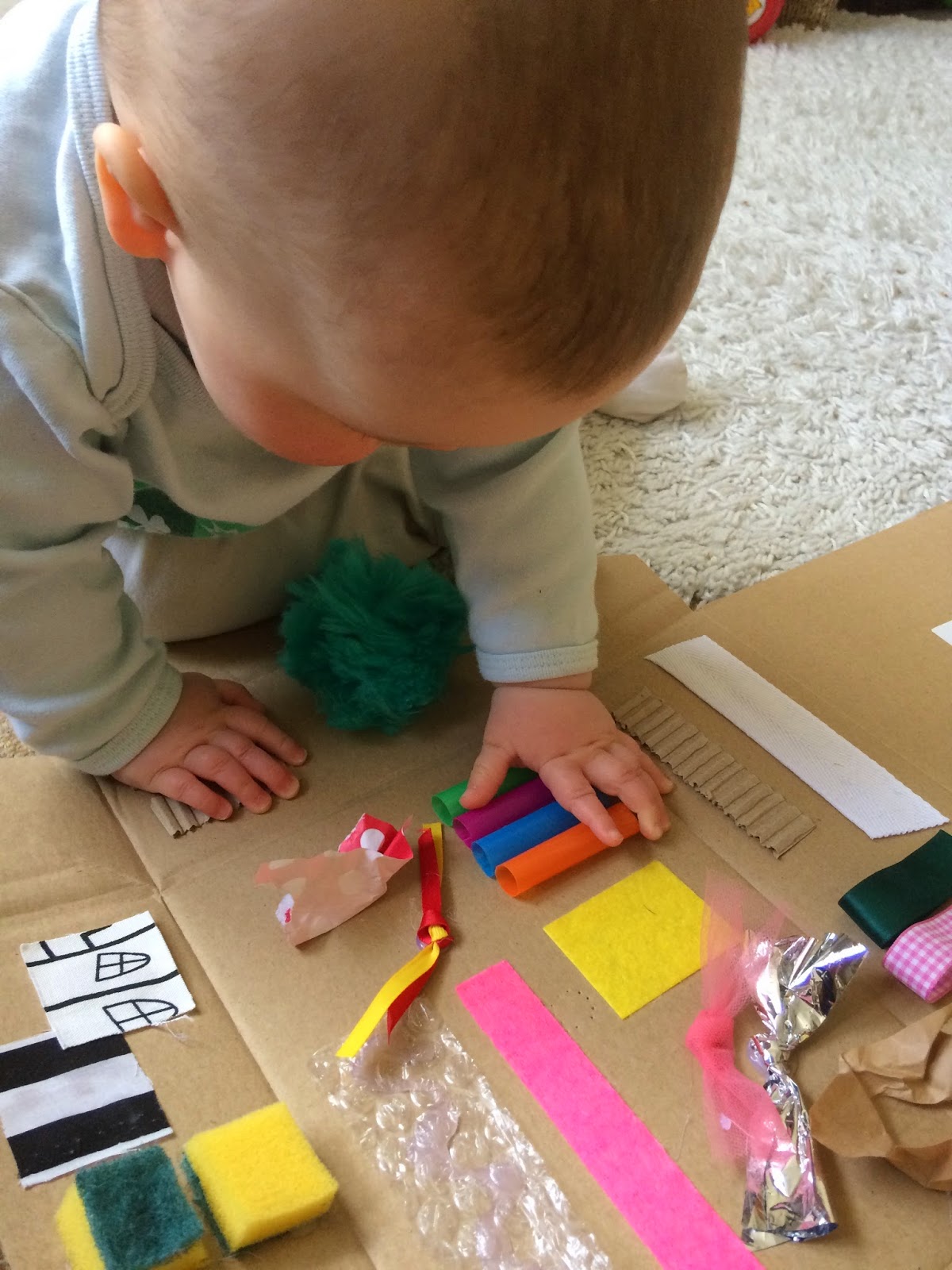
DIY sensory board

I think this is actually the make I'm proudest of even though it is incredibly simple and I can't believe I didn't think of it before. It is entirely made of things I had lying around the house and took less than 45 minutes to make from start to finish (I know because I managed to do it during one of Iz's "shorter" lunchtime naps...).  

I first got the idea from this blog and the end result is brilliant - Iz loves it, D loves it and I love how quiet they are when they play with it!! If you have anyone be vaguely "baby age" in your house I thoroughly recommend making one of these!


So what do you need?

A "base" - I was initially going to use a flat piece of cardboard but then I got my next "My Little Box" and realised it was the perfect size and shape - and the fact it folds up on itself without squashing the contents makes it perfect for storing too :)

Sensory "bits and pieces" - this is what I used:
- felt
- bubble wrap
- fabric scraps
- large straws
- big pompom
- corrugated cardboard
- loops of thick ribbon
- ties of thin ribbon
- coloured paper
- piece of emergency blanket (left over from Iz's sensory basket)
- the ziploc portion of some plastic bags

 
My aim was a variety of colours, textures and materials. Some of them also had the added element of sound. So it was a proper sensory experience - sight, touch, hearing :)

Four quick steps to make your own:

1. Assemble all the bits you want to include and lay them out on the base to get an idea of positioning
2. Glue in place with a hot glue gun
3. Leave to dry for at least 24 hours
4. Then remove any "wispy" glue bits (I clearly need to work on my glue gun technique!) and give everything a good tug to make sure it's stuck on firmly

And then play!

First exploring
  
Even D wanted to join in

Must reeeeeeeach it!

Ooooo straws


Loved the fluffy pompom

Iz loved it and probably played with it every day and before she could sit up it was great tummy time practice. We also used it to tempt her into crawling when she was first starting to move :) it was a great "go to" toy when I was trying to get lunch ready or tidy up afterwards as it would always keep her busy for at least 5 minutes.

Just checking there's nothing on the underside...

Note - before each time I gave it to her I always pulled at the various bits and pieces and checked they were all still securely in place. I would definitely advise doing that as things will invariably come loose over time.

Close up inspection

So how did it stand up to baby battering?

Amazingly well actually. The red dotted paper cup was an early casualty on day 1 (I should've realised it was just asking to be ripped off!) but everything else lasted nearly 2 months until the pompom came loose and by this point I felt it was probably past its prime. But 2 months of entertainment for the price of the glue in my glue gun - brilliant!

******

Disclaimer: as with any activity involving your baby, use your own judgement and common sense. I always closely supervise any sensory play and always inspect items for wear/tear carefully before each playing session. Always make sure you are confident with the safety of whatever your baby is playing with.

Make-your-own tutu

Ever wanted to make your own tutu? If you've got a daughter (or just like dressing up yourself...) then chances are you've bought one at some point. But they are seriously easy to make. 


Here are 2 different methods - now the world is your oyster (or tutu) as all you are limited by is what colour tulle you have :)

DIY tutu method 1

You need:
A crochet headband
Tulle 


Start off by cutting your tulle to the right length. Each piece needs to be just over twice as long as you want the final tutu length to be (see here for a chart giving rough lengths for children's ages). Then starting at the bottom of the headband (which will obviously be a waistband in this case) thread a piece of tulle in through one hole and put through the adjacent one. Then tie a single knot. Repeat all the way round the band and then depending how full you want the final tutu to be, you can add more layers above. 
After tying the first few pieces of tulle
The pink tutu below has 1 full layer and 1 half layer (with the top half later having alternate pink tulle and glitter tulle).

Teddy modelling the tutu

Once you've finished attaching your tulle just trim any lengths that aren't quite in line (it's not easy to always get the knot in exactly the same place but trimming at the end means this doesn't matter!). And there you go - a quick and easy tutu on a stretchy waistband :)


DIY tutu method 2

You need:
A ribbon
Tulle

This is even more simple than the first method and is quicker to make as you only have one double layer of tulle. So it depends which look you prefer - a fuller skirt or not. An advantage of this way is that you don't need a crochet headband and so can make the waistband as big (or small if making matching ones for a doll) as you like :)

I love this ribbon!

Tip: the quickest way I found to cut tulle - wrap it around something the right length (I used a wall calendar!) and keep wrapping round and round until you've roughly the right number of layers. Then cut through all of them  at once! Saved sooooo much time :)

Just cut along the border and you can cut 20-30 pieces of tulle in one go!

Get your ribbon or piece of elastic and measure roughly how much of it you need to cover (ie waist size). Then form a "U" shape with a piece of tulle with one side shorter than the other. Knot it onto the ribbon using either of the methods below. Make sure the shorter side lies on top of the other - this will form the upper layer of the skirt and give it more volume.

Either push through the loop

Or pull through from below

Once you've added enough tulle to go all the way round the skirt you can either tie it up with a bow or trim the ends and add some Velcro/poppers. 

Cute detail

She loves touching it :)

I love the rainbow effect and the way the knots are all different colours

So cute :)

******

So there it is - quick and simple DIY tutus - easy to make in half an hour and a fun way to spice up any outfit!

Even my toddler wanted to get in on the action :)

For my next project I am definitely going to make one of these - they look awesome!


Thursday, 30 April 2015

Water bead water bed

After making these baby-safe water bead activities I decided to upsize the sensory bag to make a giant water bead water bed... And it was just in time for the gorgeous weather last week - the perfect way to keep cool but without getting wet!


It was really simple to make and all you need is:
- some plastic sheeting (I used a disposable tablecloth from Poundland)
- some hydrated waterbeads
- duct tape
- water

I folded the tablecloth so it was 3 layers thick (I didn't trust Poundland to provide tough enough plastic sheeting for £1!!) and then duct taped three of the sides (tape-to-tape). I then put the water beads inside and duct-taped the last edge about 80% closed. Through the small opening I added some water and once there was enough added extra duct tape to close it off securely. And that's it! How simple? It felt very cool to lie on and you could feel the squishy beads through the plastic.

Next time I'm going to try and find some clear (but strong) plastic as it would be even cooler if you could see the coloured beads inside.

Tip: If you have someone else with you to help then I'd recommend filling with water at the same time as the beads and then duct-taping the last side in one go - this ensures there will be no small holes for water to leak out through.
  
How lush do these look? So fun to squidge!

Adding the water beads

Only *just* had enough duct tape to finish it!

The small opening for the water - I used a jug to pour it in

The finished product

Big enough for 2 :)

Fun to squish

Perfect for a sunny day

 ******

Disclaimer: as with any activity involving your baby, use your own judgement and common sense. I always closely supervise any sensory play and always inspect items for wear/tear carefully before each playing session. Some plastic bags will be stronger than others, and some people will use duct tape more successfully. Always make sure you are confident with the safety of whatever your baby is playing with.